
Cuong Dang
PhD Student at Virginia Tech
Electrical and Computer Engineering
Whittemore Hall
cuongdc@vt.edu
Hockey Puck Detection & Tracking
Finding a 17-pixel puck in top-down goal-camera footage
Computer VisionObject TrackingSegmentation
TL;DR. Starting from "threshold the dark pixels", I ended up with a pipeline of three parts:
- Detector: adaptive dark masks with hysteresis, shape and context filters, and a size limit derived from rink geometry.
- Player masks: a pretrained person-segmentation model, used only to reject candidates on players.
- Tracker: camera-motion compensation, a "must move" rule, fast-puck track start-up, backfill and interpolation.
Almost every component exists because of one concrete failure. The sections below follow those failures in order.
Demo
Contents
- 1. Why a puck is hard to find
- 2. Pipeline at a glance
- 3. Candidate detection
- 4. Player masks
- 5. "Only moving things can be the puck"
- 6. Tracking fast pucks
- 7. A size prior from rink geometry
- 8. Every failure and its fix
- 9. Results
- 10. Limitations and lessons
1. Why a puck is hard to find
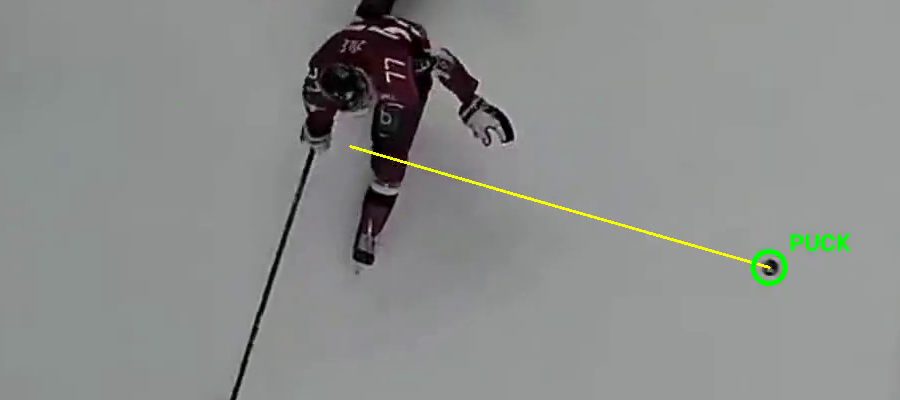
The camera looks straight down at the net. The puck is a black disc about 17 pixels across in a 1920×1080 frame. On empty ice it is easy to see. The trouble is everything else that is also small, dark and round:
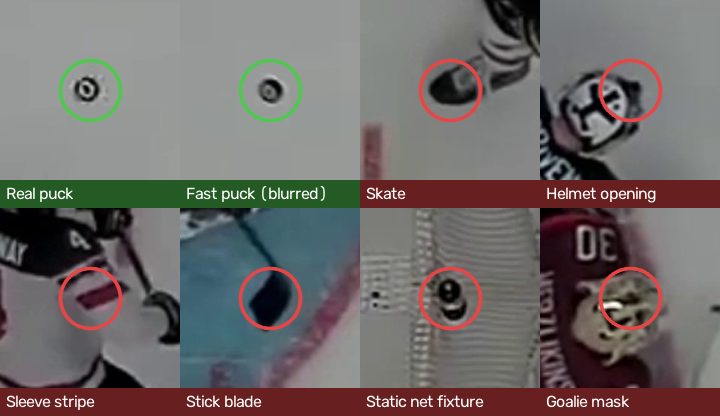
On top of that, a shot moves the puck 100–200 pixels per frame and smears it into a faint, broken ring. The video is also a compilation of 8 clips with hard cuts, and the camera occasionally pans.
2. Pipeline at a glance
Everything is classical computer vision (OpenCV + NumPy), except the purple step: a pretrained COCO person-segmentation model (YOLO11-seg) used only to say "this pixel belongs to a player".
3. Candidate detection
3.1 Thresholds relative to the ice
Motivation: the video is dim, and exposure changes between clips (ice brightness ranges from 122 to 147 on a 0–255 scale). My first fixed threshold rejected every real puck.
The ice covers most of the frame, so the median brightness is a robust reference: \[ \iota_t=\operatorname{median}_{\mathbf p}\,V_t(\mathbf p), \] and every photometric threshold is a multiple of \(\iota_t\).
Colour is tested with chroma \(C=\max_c I^c-\min_c I^c<60\) rather than HSV saturation. Saturation \(S=(\max-\min)/\max\) becomes unstable as \(\max\to 0\): near-black puck pixels came out with \(S=255\) from noise, which punched holes in the puck.
3.2 Hysteresis masks for blurred pucks
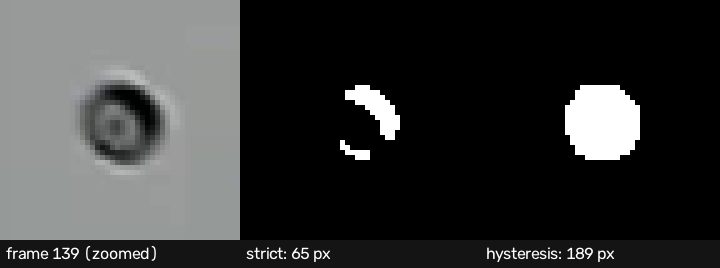
Motivation: a fast puck shows only a thin, broken dark rim. In frame 139, just 65 pixels pass the strict threshold. Simply lowering the threshold makes pucks merge with the stick blades they touch.
Fix: the same trick Canny uses for edges. Very dark pixels are seeds, and a blob grows into connected, moderately dark pixels:
\[ \mathcal S=\{V<0.45\,\iota\},\quad \mathcal W=\{V<0.70\,\iota\},\quad \mathcal M^{\text{hyst}}=\bigcup\big\{\mathcal K\in\mathrm{CC}_8(\mathcal W\cup\mathcal S):\mathcal K\cap\mathcal S\neq\varnothing\big\}. \]Both masks are then closed with a small disc, small holes are filled (the puck's bright logo makes it look like a ring), and both masks propose candidates.
3.3 Shape and context filters
| Test | Definition | Keeps | Why |
|---|---|---|---|
| circularity | \(\kappa=4\pi A/P^2\) | \(\ge0.6\) | blade fragments \(\approx0.55\) |
| elongation | rotated-rectangle sides \(a/b\) | \(\le2.3\) | a diagonal stick blade has a square axis-aligned box. Blades measured 2.5–3.2, pucks 1.0–1.9 |
| contrast ring | median of the ring \(\ge0.75\,\iota\) | bright surroundings | the puck sits alone on ice |
| clutter annulus | \(\xi=\langle \text{dark}\lor\text{coloured}\lor\text{very bright}\rangle_{12\le r<32}\) | \(\le0.35\) | jersey digits and goalie masks: 0.47–0.78. Real pucks: \(\le0.15\) |
| frame edge | blob touches the border | reject | the player it belongs to may be off-screen |
The candidate score combines these: \[ \sigma=\min\!\Big(1,\tfrac{\Delta}{\iota}\Big)\cdot\min(1,\kappa)\cdot(1-\rho)\cdot(1-\xi)\cdot\min\!\Big(1,\tfrac{A}{100}\Big), \] where \(\Delta\) is the contrast with the surrounding ring and \(\rho\) the fraction of dark pixels in that ring.
4. Player masks
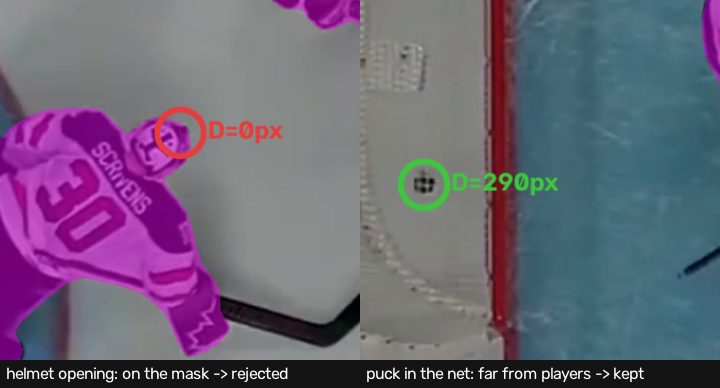
Motivation: the camera exposes for the ice, so a white jersey is about as bright as the ice. A black skate, a helmet opening or a dark sleeve stripe on a white player looks exactly like a puck on ice.
I tried seven single-frame cues: brightness, texture variance, edge density, angular enclosure, morphological "attachment to a player", colour and rotated shape. Every one of them overlapped with real pucks that sit next to players. The missing information was not about the blob; it was about where the players are.
Fix: segment people with a pretrained model and reject candidates on or near them. With player mask \(\mathcal P\), the distance transform is \[ D(\mathbf p)=\min_{\mathbf q\in\mathcal P}\lVert\mathbf p-\mathbf q\rVert_2, \] and a candidate blob \(\mathcal K\) is rejected if \(\min_{\mathbf p\in\mathcal K}D(\mathbf p)<25\) px.
5. "Only moving things can be the puck"
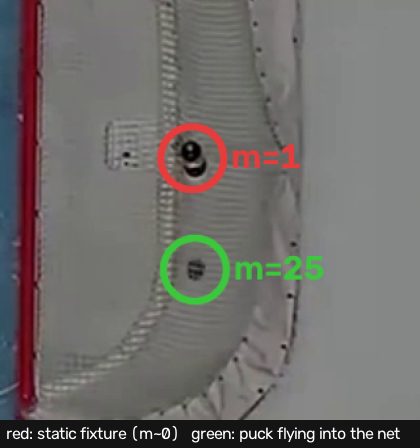
Motivation: a puck-shaped fixture at the top of the net never moves, and it was reported as the puck for about 140 frames.
5.1 Camera motion
"Not moving" must mean not moving relative to the rink, because the camera sometimes pans. Phase correlation failed here: the ice is almost textureless and the moving players dominated it. Instead, I track corner features of the static scene (rink lines, crease, net) with pyramidal Lucas–Kanade, ignoring corners on the player masks, and take the median shift:
\[ \boldsymbol\delta_t=\operatorname{median}_k\,\mathbf u_k,\qquad \mathbf x^{\text{rink}}=\mathbf x-\textstyle\sum_{\tau\le t}\boldsymbol\delta_\tau . \]5.2 Motion evidence for each detection
For each candidate, compare its neighbourhood with the same rink location 4 frames earlier:
\[ m(\mathbf c)=\Big\langle\big|G_t(\mathbf c+\mathbf u)-G_{t-4}\big(\mathbf c-(\boldsymbol\Delta_t-\boldsymbol\Delta_{t-4})+\mathbf u\big)\big|\Big\rangle_{\lVert\mathbf u\rVert\le12}. \]A track can only be the puck if its detections span at least 25 px on the rink within the last 20 frames, and at least one of its last 2 detections has \(m\ge8\). The second condition catches a track that jumps from a moving puck onto a static mark and would otherwise keep its "moving" history.
6. Tracking fast pucks
Most of my remaining "puck not detected" reports turned out to be tracker failures. The detector saw the puck; the tracker never assembled the sightings into a confirmed track. These were the fixes:
6.1 Two-point start-up, third point confirms
A brand-new track has no velocity, but a shot can move the puck 207 px in one frame, more than the original 145 px search radius. The search radius is now
\[ g=45+1.5\lVert\mathbf v\rVert+(10+0.8\lVert\mathbf v\rVert)\,\mu+220\cdot\mathbb 1[h<2], \]where \(h\) is the number of sightings and \(\mu\) the number of consecutive missed frames. After one sighting the search is wide. From the second sighting on, the window is centred on the constant-velocity prediction, so the third sighting must continue the same direction and spacing. A random pair of blobs rarely does.
6.2 Don't average the first velocity with zero
On a track's second sighting the velocity was blended 60/40 with its initial value of zero, so a 100 px/frame pass was recorded as 60. After a one-frame gap the puck was out of range. Now:
\[ \mathbf v\leftarrow\alpha\,\frac{\mathbf c-\boldsymbol\ell}{\mu+1}+(1-\alpha)\,\mathbf v,\qquad \alpha=\begin{cases}1 & h=1\\ 0.6 & h\ge2\end{cases} \]Here \(\boldsymbol\ell\) is the last actual sighting, not the coasted prediction. While the puck is hidden, the predicted speed is reduced only gently (\(\times0.9\) per frame), so an accelerating shot isn't lost behind a player.
6.3 Search again where the puck should be
Some blurred rims break into separate fragments (circularity 0.35), and loosening the global thresholds would admit far too much. If the tracked puck is missing, the detector runs again on a small window around its prediction with relaxed size and shape limits, and keeps only candidates scoring at least 0.15 (the real puck: 0.20; a crease mark: 0.09).
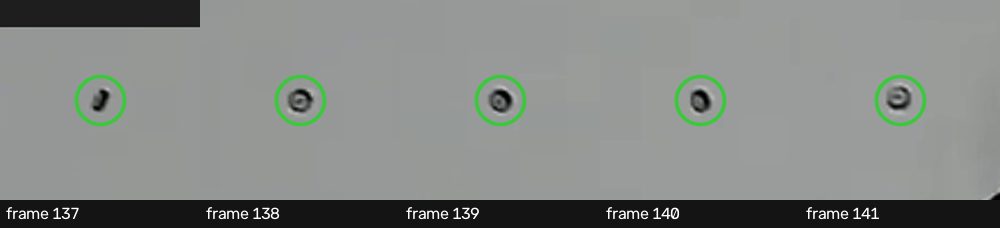
6.4 Backfill, interpolation and single-frame detections
- Backfill. A track is confirmed after 3 sightings. Results are held in a 4-frame buffer, so once a track is confirmed its earlier sightings are reported too. Otherwise the first frames of every puck appearance were missing.
- Interpolation. A frame where the puck is hidden between two sightings gets \(\hat{\mathbf x}_\tau=\mathbf c_k+\frac{\tau-t_k}{t_{k+1}-t_k}(\mathbf c_{k+1}-\mathbf c_k)\), which is more accurate than a forward prediction.
- Single frame. A puck crossing a corner of the view can be visible in one frame only. It is reported on its own when nothing else is reported and the evidence is very strong: \(\sigma\ge0.6,\ m\ge30,\ \xi\le0.1\). In the whole video exactly two candidates meet this, and both are real pucks.
7. A size prior from rink geometry
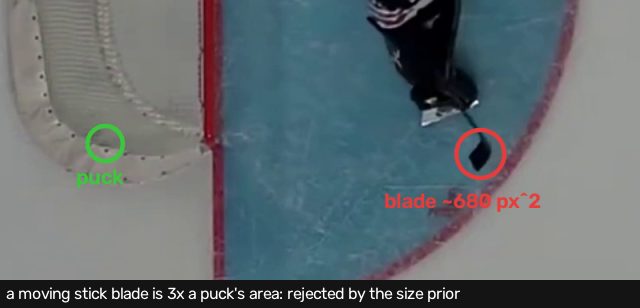
Motivation: the goalie's moving stick blade (frames 610–620) beat a faint puck in the net. It is dark, moving and roundish, but 3–6 times larger than a puck.
Fix: derive the puck's size from the rink itself. The goal crease radius is 6 ft and spans about 420 px, so the scale is \(k\approx70\) px/ft. A 3-inch puck is therefore
\[ d_{\text{px}}=k\cdot 0.25\ \text{ft}\approx17.5\ \text{px},\qquad A_{\text{puck}}=\tfrac{\pi}{4}d_{\text{px}}^2\approx240\ \text{px}^2 . \]Allowing about 2.25× for motion blur and shadows gives \(A\le540\) px². Measured: blades 598–688 px², every real puck at most 475.
8. Every failure and its fix
| Symptom | Root cause | Fix |
|---|---|---|
| nothing detected | absolute thresholds on a dim video | ice-relative thresholds |
| puck in the net missed | HSV saturation noisy near black | chroma |
| jersey digits, goalie mask | dark blobs on fabric | clutter annulus (all colours) |
| stick blade on pads | diagonal blade has a square box | rotated-rectangle elongation |
| skates, helmets, sleeves | white jersey ≈ ice brightness | person segmentation |
| static net fixture | no notion of motion | camera compensation + motion rule |
| track jumps onto a mark | motion judged per track only | per-detection motion evidence |
| blurred fast puck | broken thin rim | hysteresis mask + re-detection near the prediction |
| shots never confirmed | 145 px gate, heavy damping | two-point start-up, speed-aware gate |
| pass lost after a 1-frame gap | velocity blended with zero | \(\alpha=1\) on the 2nd sighting |
| first frames missing | 3-sighting confirmation | backfill |
| one-frame puck | no track possible | strong single-frame rule |
| stick blade chosen over the puck | loose area limit | geometric size prior |
| tracks across clip cuts | compilation video | frame-difference cut detector |
9. Results
| Version | Frames with a detection | What changed |
|---|---|---|
| classical detector + tracker | 35.5% | many false positives |
| + player masks | 29.2% | skates and helmets removed |
| + motion rule | 13.0% | ~140 frames of a static fixture removed |
| + hysteresis mask, re-detection | 25.7% | fast pucks recovered |
| + fast-puck tracking, backfill | 33.1% | shots confirmed, gaps filled |
| + size prior | 32.7% (+18.6% predicted) | stick blade replaced by the real puck |
The share of detected frames went down before it went up. The early numbers were inflated by false positives, and each filter first removed those before the tracking work recovered real pucks. Much of the remaining "lost" time is genuine: the puck is under a goalie's pad, in a glove, or off-screen.
10. Limitations and lessons
- A puck carried on a stick blade merges with the blade into one shape and is missed.
- A puck touching a player (within 25 px of the mask) is rejected along with the skates and gloves.
- A stationary puck is not reported unless the "moving only" rule is turned off; that is by design.
- The size prior assumes this camera's zoom (about 70 px/ft) and must be rescaled for other footage.
Lessons.
- When single-frame features stop separating classes, add a different kind of information. Here that was where the players are, and whether it moves.
- Separate detector failures from tracker failures. Most late "missed puck" bugs were tracker start-up logic, not detection.
- Derive constants from the scene when possible. The rink's known dimensions gave the size limit for free.
- Audit every detection by eye. Two of my own "true puck" labels turned out to be a skate toe and a stick blade.